Double girder EOT cranes are the workhorses of heavy industry — built for higher capacities, longer spans, and more demanding duty cycles than single girder designs. But greater capacity also means greater risk if the engineering, materials, or testing fall short. When evaluating a double girder EOT crane manufacturer in India, safety and quality assurance should be non-negotiable filters, not afterthoughts.
Design compliance. A reputable manufacturer designs cranes in line with recognized Indian and international standards for crane structures, electricals, and lifting components — commonly referencing IS codes for crane design and safety, alongside relevant international benchmarks such as FEM or CMAA duty classifications. Ask any prospective supplier which codes they design to, and request documentation, not just verbal assurance.
Material traceability. Structural steel, wire ropes, hooks, and gearboxes should come with mill test certificates and traceable sourcing. This matters because a crane’s safety margin is only as reliable as the materials that went into it — and traceability is what allows a defect to be tracked back to its source if one ever surfaces.
Load testing and inspection. Every crane should undergo static and dynamic load testing before dispatch, typically at 125% and 110% of rated capacity respectively, along with documented inspection of welds, brakes, and limit switches. Insist on seeing test certificates, not just a delivery note.
Safety devices as standard, not optional. Overload protection, limit switches, anti-collision systems, and emergency stop mechanisms should be built into the base specification, not sold as costly extras. A manufacturer who treats these as standard is signalling that safety is part of their design philosophy, not a checkbox.
After-installation support. Safety doesn’t end at commissioning. Look for manufacturers who provide installation supervision, operator training, and a clear preventive maintenance schedule — because most crane incidents trace back to poor maintenance or untrained operation, not design failure.
Choosing a double girder EOT crane manufacturer on price alone is a common but costly mistake. The right question isn’t “what’s the cheapest quote?” but “what’s the total cost of ownership, including safety, uptime, and service life?”
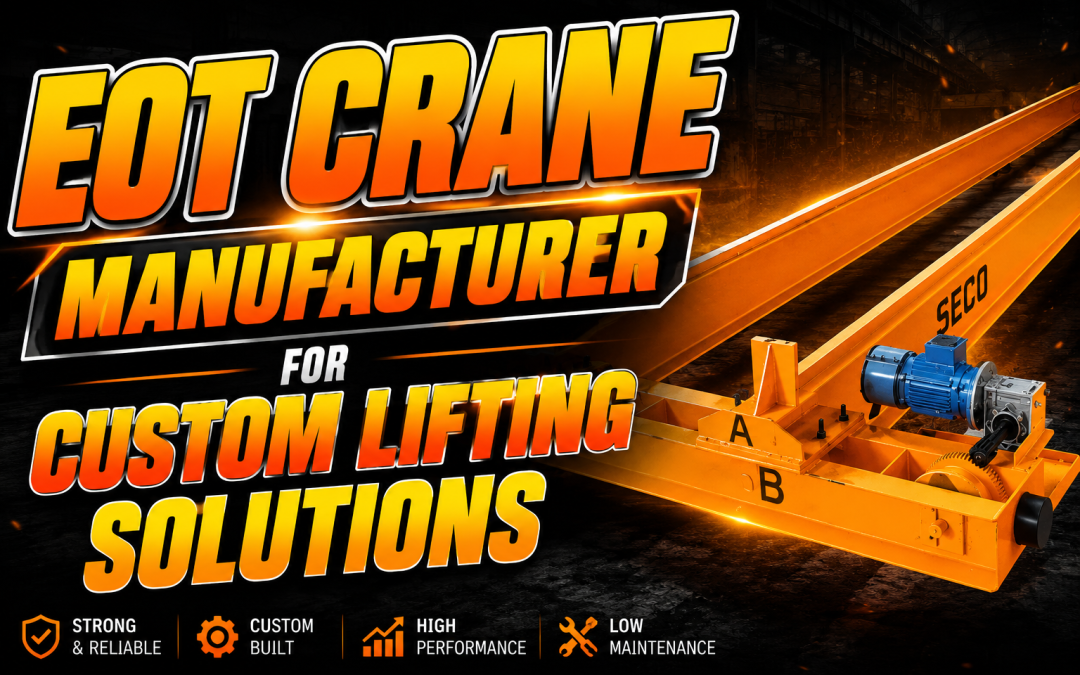
EOT Crane Manufacturer for Custom Lifting Solutions
When a production line stalls because material handling can’t keep pace, the cost isn’t just measured in hours — it’s measured in missed shipments, unhappy clients, and idle labour. This is why choosing the right EOT crane manufacturer matters as much as choosing the crane itself. An Electric Overhead Traveling (EOT) crane is only as good as the engineering, testing, and after-sales support behind it, and that’s where working with an experienced, India-based manufacturer makes a measurable difference.
Custom lifting solutions aren’t a luxury add-on anymore — they’re a competitive necessity. Standard, off-the-shelf cranes rarely match the exact bay width, headroom, duty cycle, or load profile of a real factory floor. A manufacturer who understands your industry, your site constraints, and your safety obligations can design a crane that fits the job instead of forcing the job to fit the crane.
In this article, we’ll look at the industries that rely most heavily on Indian EOT crane manufacturers, what separates a safe and compliant double girder crane from a risky one, and why the right manufacturing partner — not just the right product — should be at the centre of your decision.
Top Industries Served by Indian Crane Manufacturers
EOT cranes are a backbone technology across heavy industry, and Indian manufacturers have built deep expertise in serving sectors with very different lifting demands.
Steel and metal processing. Steel plants need cranes that can handle continuous, high-temperature operations — moving ladles, billets, coils, and scrap with precision and minimal downtime. These environments typically call for higher duty-class cranes built to withstand heat, dust, and near-constant cycling.
Automotive and heavy engineering. Assembly lines depend on cranes for moving engine blocks, chassis components, and dies between workstations. Here, speed and repeatable positioning matter as much as raw lifting capacity, since even small delays ripple down the line.
Cement and power plants. These facilities need cranes rated for extremely heavy, often irregular loads — turbine components, boiler parts, and raw material handling — usually in high-ambient-temperature or dusty conditions that demand robust electricals and enclosures.
Warehousing and logistics. As Indian warehousing has modernized, EOT and jib crane systems have become common for palletized and bulk goods movement, particularly where forklifts alone can’t safely or efficiently handle the load height or weight.
Shipbuilding and heavy fabrication. Fabrication yards need cranes capable of lifting oversized, irregularly shaped components — often demanding custom span, headroom, and lifting-beam configurations that a catalogue crane simply can’t provide.
Construction and infrastructure. Precast yards, bridge girder assembly, and large infrastructure projects frequently use EOT cranes for material staging and heavy component placement on site.
Across all these sectors, one theme repeats: the load profile dictates the design. A manufacturer serving multiple industries develops a broader engineering vocabulary — which is exactly why experience across sectors, not just years in business, is a meaningful signal of capability.
Why Choose Shyamo Engineers among EOT Crane Manufacturing Company
With no shortage of EOT crane manufacturing companies competing for attention, what should actually tip the decision in a buyer’s favour? Here’s where Shyamo Engineers positions itself differently.
Faridabad-based manufacturing with regional expertise. Operating out of Faridabad, Haryana — a major industrial hub in the Delhi-NCR belt — Shyamo Engineers is close to a dense concentration of steel, auto ancillary, and heavy engineering units, allowing for faster site visits, quicker turnaround on custom quotes, and a practical understanding of local industrial conditions.
Customization as a core capability, not an afterthought. Rather than pushing standard catalogue models, the design process starts with the client’s actual site conditions: bay dimensions, load type, duty cycle, and ambient environment. This engineering-first approach is what “custom lifting solutions” should actually mean in practice.
Focus on compliance and documentation. In an industry where cutting corners on testing or certification can go unnoticed until an incident occurs, working with a manufacturer that treats compliance as standard practice — not a premium option — reduces long-term liability for the buyer.
Responsive, relationship-driven service. Heavy machinery purchases aren’t one-off transactions; they’re the start of a long service relationship involving spares, maintenance, and eventual upgrades. A manufacturer who stays reachable after the invoice is paid is worth more, over a crane’s 15-20 year service life, than one who simply undercuts on the initial quote.
Transparent process from enquiry to commissioning. Buyers making a significant capital investment deserve clear timelines, transparent pricing breakdowns, and honest communication about lead times — especially for custom fabrication work where delays are common industry-wide.
Choosing an EOT crane manufacturer is ultimately a decision about who you trust to keep your operation running safely for the next two decades. Experience across industries, a demonstrable commitment to safety and testing, and a willingness to engineer around your actual site — not a generic template — are the factors that should guide that decision.
Frequently Asked Questions
1. What is the difference between a single girder and a double girder EOT crane? A single girder EOT crane uses one main beam and is typically suited for lighter loads and shorter spans, making it more economical for lighter-duty applications. A double girder EOT crane uses two parallel beams, allowing for higher lifting capacities, longer spans, and a lower headroom loss — making it the preferred choice for heavy industrial applications like steel handling and large-scale fabrication.
2. How do I know if I need a custom-built EOT crane instead of a standard model? If your facility has non-standard bay widths, unusual headroom constraints, irregular load shapes, or a duty cycle heavier than typical intermittent use, a standard catalogue crane may not perform safely or efficiently. A site assessment by the manufacturer — reviewing your building structure, load type, and operating pattern — is the most reliable way to determine whether a custom design is necessary.
3. What safety certifications should an EOT crane manufacturer be able to provide? At a minimum, expect design documentation referencing applicable IS codes for crane structures and safety, along with load test certificates for static and dynamic testing before dispatch. Depending on your industry and location, additional third-party inspection certificates may also be required.